


Yesterday I visited the Armani/Silos in Milan and couldn’t stop admiring the craftsmanship—until it hit me: I’ve seen something similar before. Back home. Not in a gallery, but in my mother’s wardrobe. On relatives at weddings. At the tailor’s. In fabric being cut on a living room floor.
I grew up around this kind of work—embroidery, hand-dyeing, delicate threadwork—and I never thought much of it. It was just… there. Part of celebrations, rituals, routines. I didn’t realize how rare it actually was, or how much skill it took.
In many parts of the world, having something made by hand is a luxury. Here, it’s routine. But routine doesn’t mean ordinary. And that’s something I had to learn.
India is just one example—but it’s one I know closely. There’s an incredible amount of skill here, passed down over generations. Intricate hand embroidery, weaving, dyeing, tailoring—all done with precision and patience. Zari work uses real gold or silver, beaten into thread and woven into fabric by hand. Chikankari is stitched slowly, one soft motif at a time. Bandhani, our traditional tie-dye, involves thousands of tiny knots before a single drop of dye is applied. It’s not fast. It’s not mass-produced. But it’s art. And it lasts.
I’ve seen pieces in my family passed down, worn, and reworked—a sari turned into a suit, then a dress, then passed on to someone else. Nothing wasted. Just made new again. That’s what I find so beautiful about craft: it doesn’t just decorate. It continues.
Across the world, we often define luxury through branding, price, and exclusivity. But what gives a piece real value is something else entirely: the hands. The hours. The craft. And what we overlook as everyday is often the most extraordinary part of it all.


And yet, that part of fashion—the making—is still rarely shown. We celebrate the final garment, but not the people behind it. We know the designer’s name, but not the karigar, the artisan, the weaver. For a long time, showing process was seen as too raw, too real—too far from the fantasy fashion is meant to sell.
But that’s finally starting to change.
Today, more brands are letting us in. Loewe shares quiet, detailed videos of their pieces being built stitch by stitch. Sabyasachi shows us threadwork, sequins, hands at work. Dior’s India-inspired Fall 2023 show acknowledged its artisans openly—filming them, crediting them. And when you see those stories—the time, the precision, the people—something shifts.
A few days ago, I had the chance to visit one of the producers behind bags for brands like Chanel and Jacquemus—and I was stunned. There was so much care, so much quiet precision. We watched artisans glue each piece by hand, fix tiny gold hardware onto every edge, package every item like it mattered. It felt like watching a dream being assembled in real time. And the moment stayed with me. Because once you witness that level of detail—the people, the patience—you start to understand the product differently. You respect it more. You see why it costs what it does. This is the part more brands need to show—not just to impress, but to justify. To make us see the value beyond the logo.
What we wear isn’t random. It might feel that way sometimes—a bag is just a bag, a dress is just a dress. But behind every seam, there’s thought. Every thread, color, cut has been chosen. Shaped by hand. A Hermès bag, for instance, takes over 20 hours and 36 individually cut pieces of leather to assemble. That level of savoir-faire is why maisons like Chanel now own ateliers like Maison Lesage—to preserve the craft, not just the brand. As Miranda Priestly once said, even a lumpy blue sweater comes from a lineage of decisions. The difference now? Consumers want to understand that lineage. And brands owe it to them. Because when you know what goes into a piece, you carry it differently, you hold onto it longer. And it’s on the brand to remind us of that. Every time.
Just recently, a Tory Burch mirrorwork dress—crafted in India using traditional sheesha embroidery—went viral as a trend, despite women in South Asia having worn similar work for generations. The technique isn’t new. It just finally got noticed.
Today’s abundance is tomorrow’s rarity. And what we’ve called “everyday” for too long might soon be gone—unless we start paying closer attention.

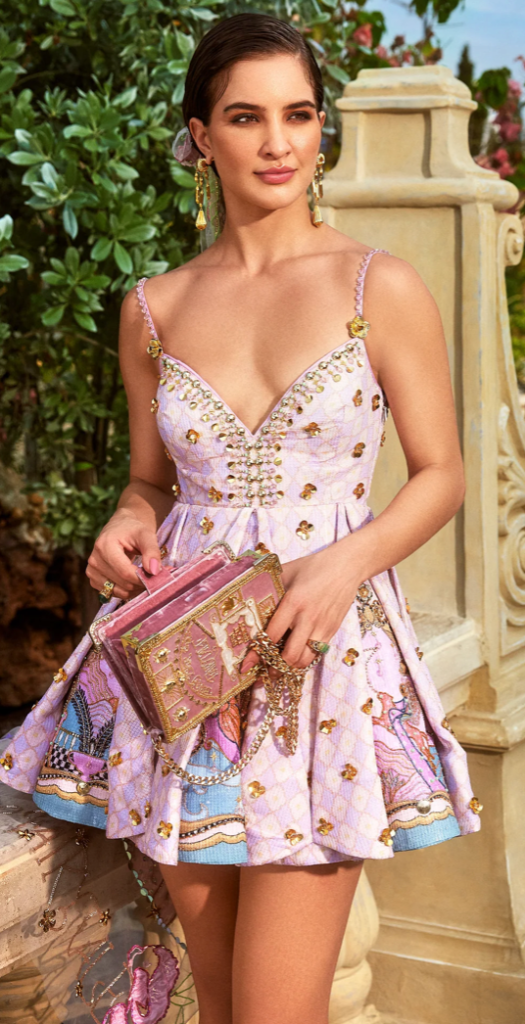

This post isn’t just about India. It’s about every culture that’s carried fashion forward quietly—through techniques, not trends. From Japanese indigo dyeing to Palestinian tatreez, from French ateliers to African batik makers—craft has always been there. We’re just finally paying attention.
Luxury has always been about rarity. But maybe it’s time we see rarity not just in silhouettes or scarcity—but in patience. In process. In things that are made to mean something.
Craftsmanship isn’t the past. It’s the part of fashion that still has a soul. And the more we make space for it, the more connected we feel to what we wear.
If you want to see this kind of craftsmanship in action, I’d really urge you to watch Dior’s India-inspired Fall 2023 show.
Or just take a closer look at something handmade. It might surprise you how much you’ve already been carrying.
– Sakshi Agrawal

 Noir et Blanc